Why archival cotton rag paper matters
Two prints of the same image can look identical on the day they arrive and completely different a decade later. What separates them is almost never the ink. It is the paper.
What cotton rag actually is
Ordinary paper is made from wood pulp, which contains lignin — the compound that makes trees rigid. Lignin oxidises in light and air, producing acid, and that acid yellows and embrittles the sheet from within. It is why old newspaper turns brown.
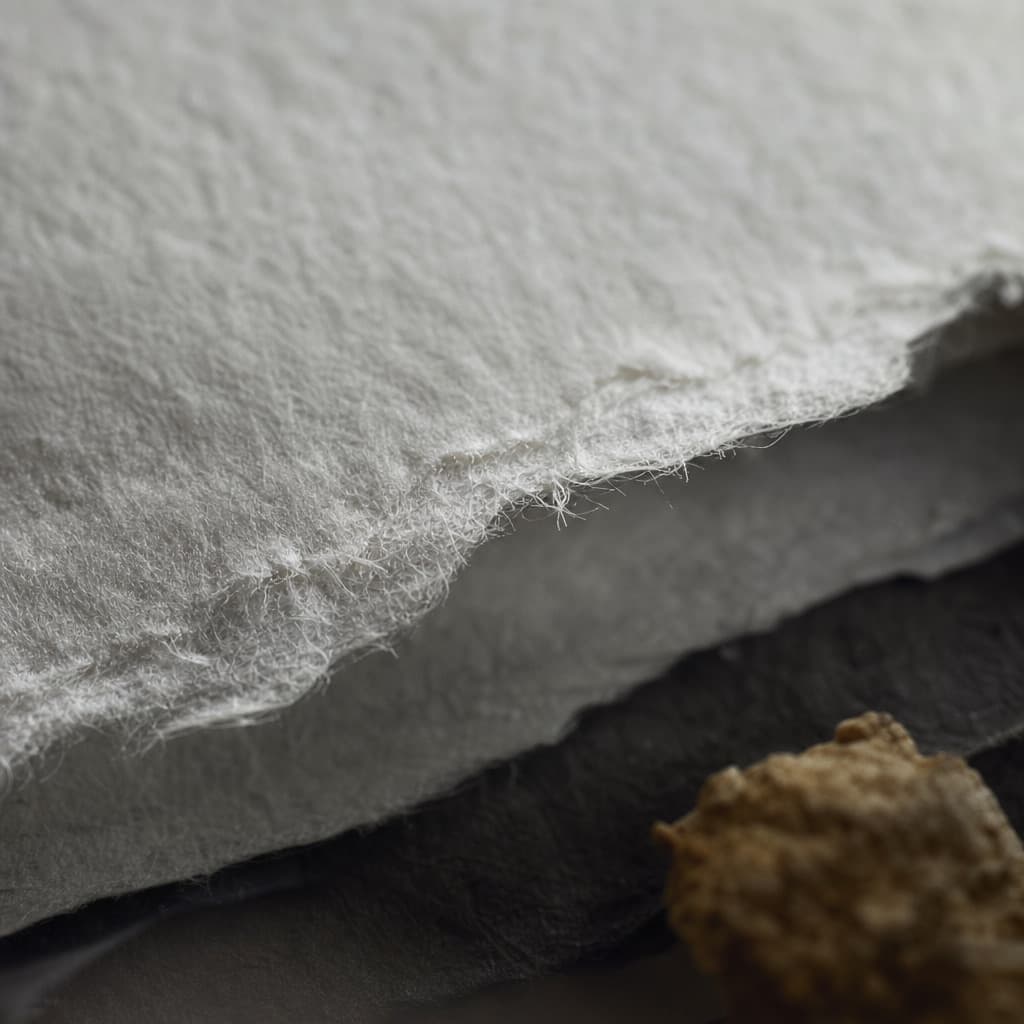
Cotton rag paper is made from cotton fibre and contains no lignin at all. There is nothing in it to turn acidic. A 300 gsm cotton rag sheet stored reasonably will look the same in a century.
Why it changes how the image looks
Cotton fibre is longer and more absorbent than wood pulp. Pigment sits slightly into the surface rather than on top of it, which does two things: blacks go deeper, and the image gains a matte, slightly textural quality that reads as a print rather than a poster.
The trade-off is honest: cotton rag cannot reach the extreme gloss and contrast of resin-coated photo paper. For a painting reproduction that is the right compromise. For a high-gloss photograph it might not be.
Reading a specification
| Term | What it means | Does it matter |
|---|---|---|
| 100% cotton | No wood pulp, no lignin | Yes — this is the whole point |
| Acid-free | Neutral pH today | Weakly. Wood pulp can be acid-free now and acidic later |
| 300 gsm | Weight; roughly card thickness | Yes — thin paper cockles in a frame |
| OBA-free | No optical brighteners | Yes — brighteners fade, shifting whites warm |
| Pigment ink | Ground particles, not dye | Yes — dye inks fade in years, pigment in decades |
The part you control
Archival paper and pigment ink give a print the ability to last. Whether it does depends on you: UV-filtering glazing, an acid-free mount, and a wall out of direct sun. Good materials badly hung will still fade — just more slowly than bad ones.