How a silver piece is cast to order
Buying something made to order means waiting without seeing the work happen. Here is what fills that time.
1. The terrain becomes a model
The coordinates you chose are used to pull elevation data for that patch of ground. Those heights become a three-dimensional surface: every point on the grid is a real measured altitude, scaled up vertically so the landscape can be felt.
What you see turning in the configurator is that surface. The file sent to production is the same geometry at higher resolution.
2. The model becomes a pattern
The digital model is printed in castable resin at high resolution — fine enough to hold a ridge line a fraction of a millimetre across. This pattern is a single-use object. It exists to be destroyed.
3. Lost-wax casting
The pattern is set into a flask and surrounded by investment plaster. The flask goes into a kiln, where the resin burns away completely and leaves a cavity in the exact shape of your piece — the ‘lost’ part of lost wax.
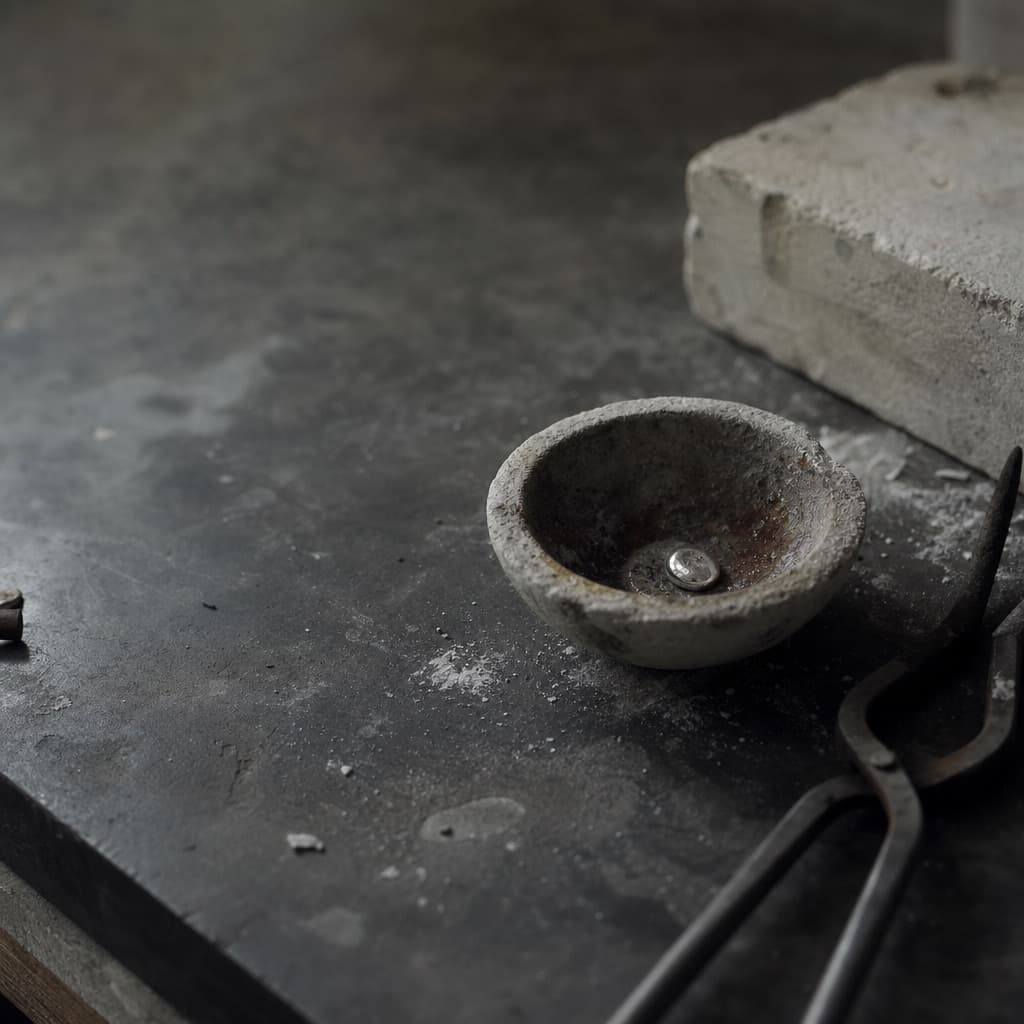
Molten silver is then drawn into that cavity under vacuum or centrifugal force. Vacuum matters here: it pulls metal into the fine relief that gravity alone would not fill, which is the difference between a crisp ridge and a rounded blur.
This method is roughly six thousand years old. Nothing has replaced it because nothing needed to.
4. Breaking out and finishing
The plaster is broken away — destroyed too, like the pattern. The raw casting comes out grey and rough, with a sprue where the metal entered, which is cut and filed back by hand.
Then the finishing, which is where the hours go. The flat areas are polished. The relief is not polished flat: a landscape reads because its low points hold shadow, and a mirror finish everywhere would erase the terrain visually while leaving it physically intact.
5. Hallmarking and dispatch
The piece is stamped with its silver mark, cleaned, checked against your configuration — coordinates, size, engraving — and packed.
Why it takes weeks
Because every stage above happens once, for one object. There is no shelf to take it from. That is the cost of the thing being yours, and it is the honest reason the date is confirmed rather than promised on the product page.