Topography as memory: why we keep the shape of places
Ask someone why they have a photograph of a coastline on their desk and they will rarely say it is a good photograph. They will tell you what happened there.
Landscape, in private life, almost never functions as scenery. It functions as a marker — a way of holding a date, a person, a decision, in an object that does not embarrass you by saying so out loud.
Why the shape works better than the picture
A photograph of a place fixes one moment: this light, this weather, this season. It ages, and it ages specifically — you can date it.
The terrain of a place does none of that. It is the same shape in every season and every century of a human life. Reduced to its elevation, a place becomes abstract enough to live with daily and specific enough that only you know what it is.
That combination — unreadable to strangers, unmistakable to you — is what a good memento needs. It is the reason a wedding ring is a plain band rather than an engraved scene.
What survives the translation
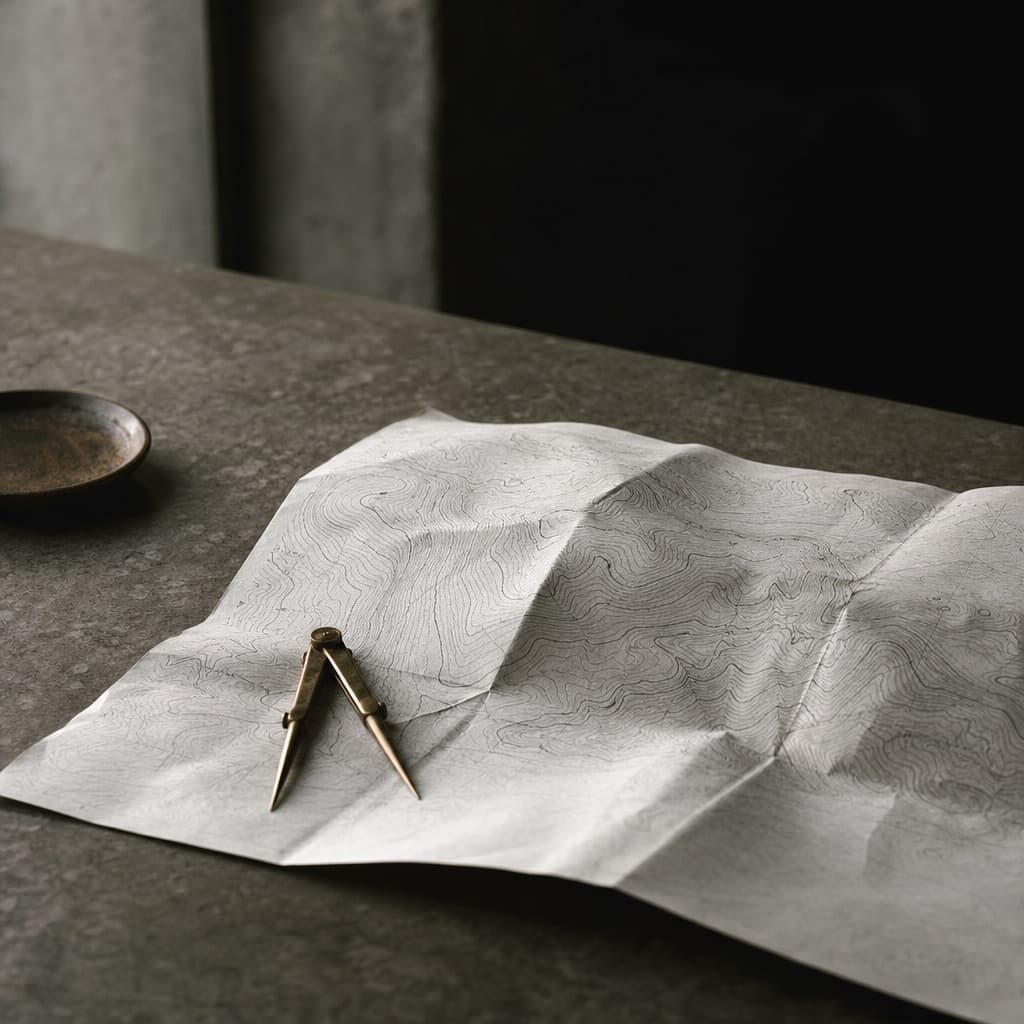
Elevation data covers effectively all land on earth, at a resolution fine enough to render a valley or a ridge but not fine enough to render a building. That limit is useful. What survives the translation into paint is the structure of a place: where it rises, where it falls, which way the water ran.
Height has to become colour. On a flat canvas a valley and a ridge are told apart by bands of tone, the way old survey maps did it, and the bands are drawn more boldly than the land itself rises. That is closer to how memory works anyway. Nobody remembers a place to scale.
Choosing a place
The places that work best are rarely the famous ones. A named summit makes a handsome object, but it belongs to everyone. A stretch of unremarkable coast where something happened belongs to one person, and it makes the better piece.
Flat places produce flat objects — a plain, a delta, a city on a floodplain will read almost smooth. That is worth knowing before you order, and it is why the configurator shows you the result before you commit.